
Mistral Large 4 'Le Chonk' lands in Transformers: 1T parameters, 1M context, 3,800 Blackwell GPUs
Transformers v5.22 adds Mistral's largest model: 1T total parameters with 49B active per token, a 1M context and native multimodality, plus an FP8 adapter-training memory win.
Transformers shipped v5.22.0 on October 29 with a one-line headline: Mistral Large 4 (Le Chonk). I laughed at the name first. “Le Chonk” is French for something like chubby, attached to a trillion-parameter model, which reads as a self-aware joke.
Then I read the body and stopped laughing.
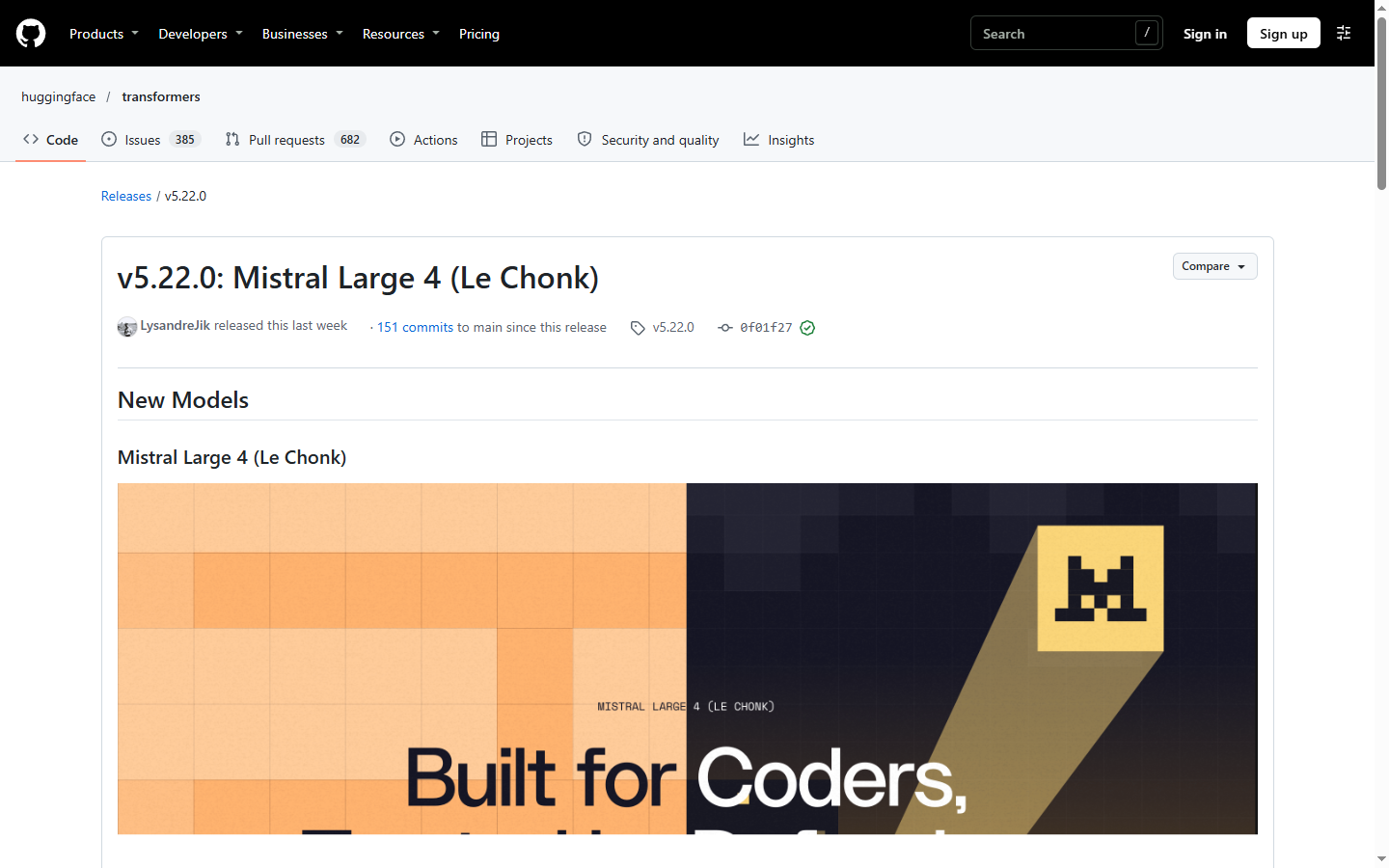
The numbers first
- 1T total parameters, roughly 49B active per token (52B counting embeddings and output layers)
- 128 routed experts, 4 active per token, plus 1 shared expert
- 1M context window
- Natively multimodal: text and image input, a Pixtral-style vision encoder handling variable sizes and aspect ratios
- Three reasoning efforts:
low,medium,high, defaulthigh - 160+ languages, including every official EU language
The line that matters is buried in the training notes: the model was trained from scratch on 3,800 NVIDIA Grace Blackwell GPUs in Mistral’s own European datacenters. Not fine-tuned, not distilled. From scratch.
What 1T parameters means, and it is not “runs on your GPU”
An unpopular but honest framing: for most of us, releases like this do not mean “I can use it”. They mean “I now know where the ceiling is”.
The MoE design exists for exactly this. Total parameters buy knowledge, active parameters keep inference cost down. A 1T/49B ratio, about 5%, means one forward pass costs roughly what a 49B dense model costs rather than a 1T one. Every open model of the last two years has walked the same road.
But “similar compute to 49B” is not “fits on a 49B machine”. All the weights still have to live in memory. The people who actually run this are the ones already buying H100s and B200s. For those of us on our own hardware, the value in this release is elsewhere, in the next section.
The memory win is the part normal people can use
A quieter entry in the same release: FP8 quantized models can now be used for adapter training (LoRA, PEFT), because backward passes were added for dense and grouped FP8 matmuls and is_trainable is now True.
The measured effect: MoE backward peak memory at 8k tokens drops from about 28.9 GiB to 2.8 GiB.
That number is worth more to me than a trillion parameters. 28.9 GiB means a 40GB card barely manages and a 24GB card is out. 2.8 GiB means consumer hardware can fine-tune MoE models. Open-source progress usually hides in entries like this rather than in headlines.
Licensing: commercial use yes, MaaS no
The model ships under the Mistral Ecosystem Open-Weight License, a modified MIT. Commercial and non-commercial use are both allowed, but running a model-as-a-service business requires a separate commercial license.
It is a clear line: weights to you, business to them. Fine for internal tools, research and derivative work. A hard red light for anyone planning to resell an API.
My read
The immediate effect of a trillion-parameter open model is not that everyone gets the strongest model. It is that the price anchor set by closed models moves down. Comparable capability, permissive license, downloadable weights: once those three line up, procurement conversations change.
Should you try it now? With a machine that can hold a few hundred gigabytes of weights, yes: pull it and compare reasoning_effort="high" against whatever you use today. Without one, the more useful change is the FP8 and adapter-training work that landed in 5.22.2 on November 6.
Comments
…