
Undersea Cables: The Physical Backbone of the Internet
Every overseas site you open probably travels through a glass fibre on the ocean floor. This is how submarine cables are built, how fragile they are, who lays them, and why satellites cannot replace them.
Open a site hosted in the United States and your data goes under the sea. Not via satellite, and not through some mysterious cloud, but through a few dozen strands of glass fibre wrapped in steel and dropped onto the ocean floor four kilometres down.
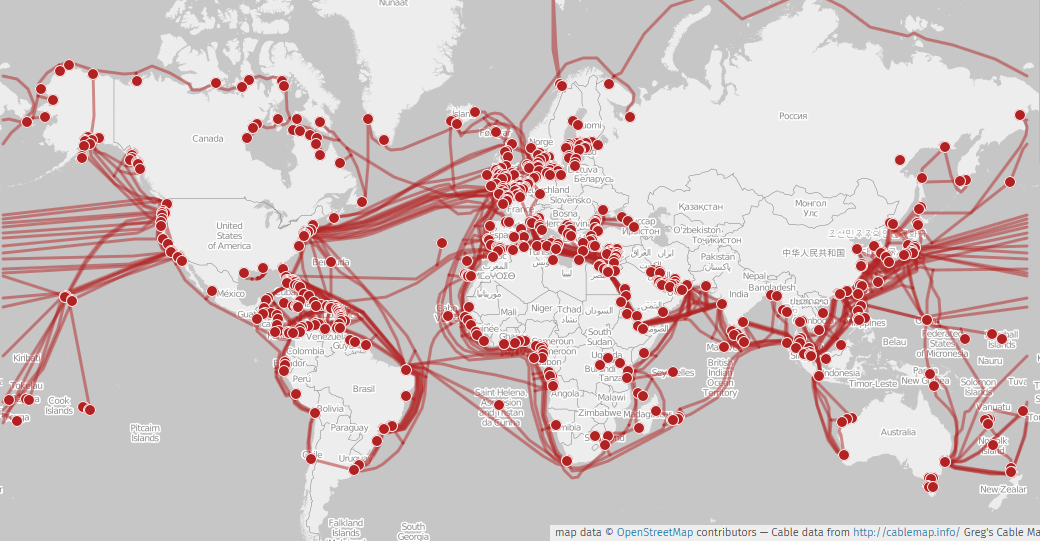
Image: Submarine cable map (cable data © Greg Mahlknecht, base map © OpenStreetMap contributors), CC BY-SA 2.0, via Wikimedia Commons.
What one cable actually is
A submarine cable is not a very long network patch cord. At its core are a few bundles of fibre as thin as a hair, wrapped in a silicone buffer, an aluminium water barrier, high-strength steel strands, and finally a polyethylene jacket. The shallow-water section, anywhere above roughly two hundred metres, gets an extra layer of steel armouring to survive anchors and trawler nets.
What makes a cable span an ocean is the repeater. Light fades to noise after a few dozen kilometres of fibre, so every 60 to 80 kilometres a splice housing carries an erbium-doped fibre amplifier that re-boosts the signal. The repeaters have no local power. They are fed a few thousand volts of DC from both shores. A cable is therefore both a light path and a power circuit, and losing power is as fatal as cutting the fibre.
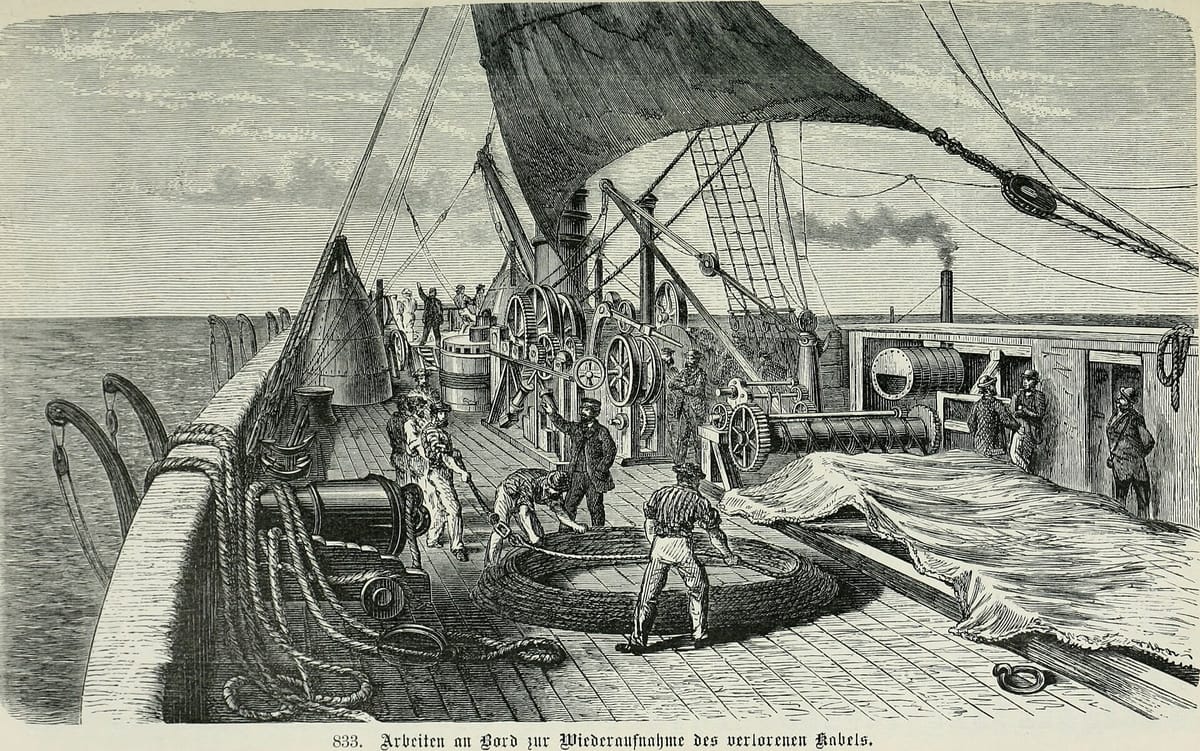
Image: Der Weltverkehr und seine Mittel (1913, author unknown), public domain, via Wikimedia Commons.
It is fragile in a very ordinary way
Most cable faults are caused by people: dragged anchors, bottom trawls, dredging. Earthquake-triggered underwater landslides are the other big one. The 2006 Hengchun earthquake cut several Asia-Pacific cables at once; a cluster of Red Sea breaks in 2024 forced a large share of Europe-Asia traffic onto long detours.
Repair takes longer than most people expect:
- Locate the break from both ends with an optical time-domain reflectometer, usually within a few hundred metres.
- Send a cable ship from the nearest base port; a one or two week voyage is normal.
- Haul the cable onto the deck, splice it, test it, and lay it back on the seabed.
A deep-water repair often takes a month from confirmed fault to restored service. That is why routing redundancy is not a nice-to-have. It is why several cables from different operators tend to lie in the same sea, side by side.
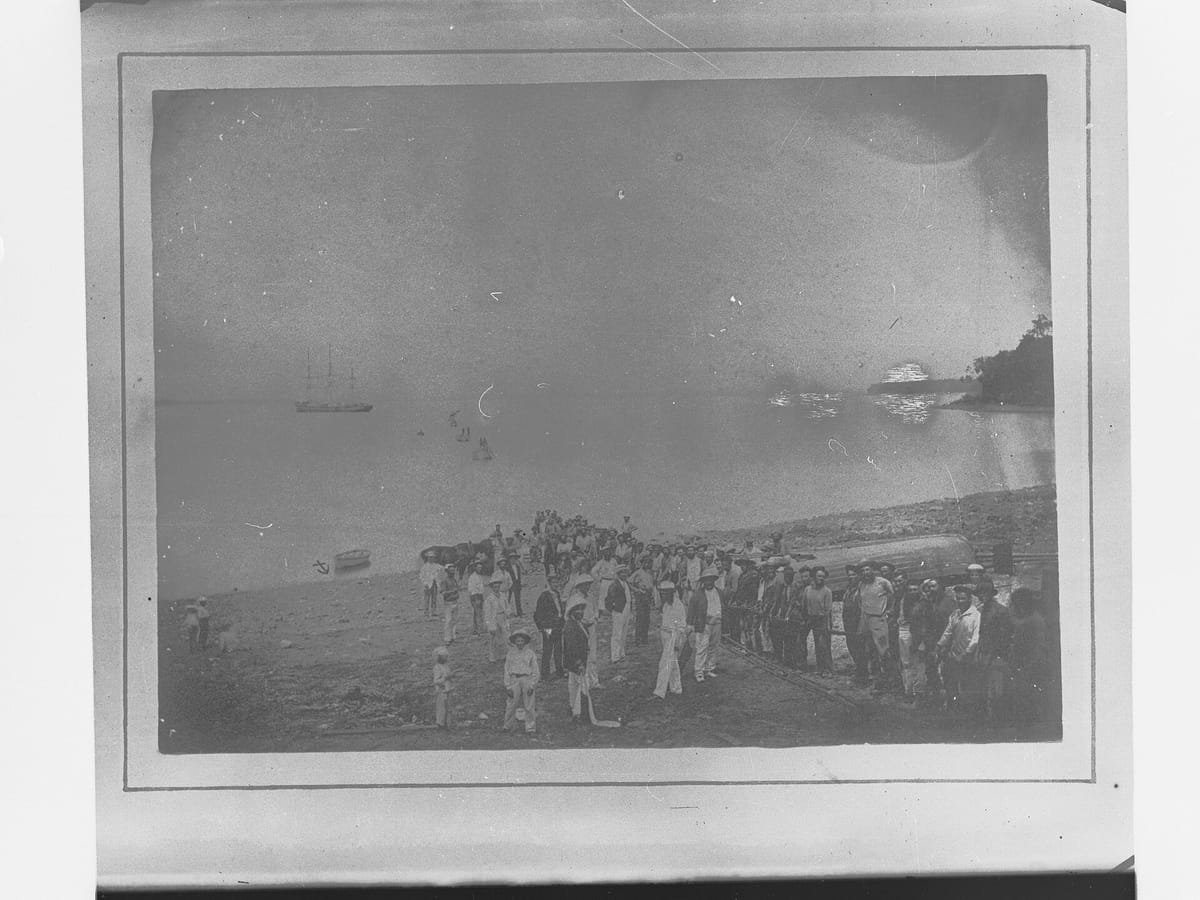
Image: Landing of the submarine cable, Port Darwin, 1871 (State Government Photographer), CC0, via Wikimedia Commons.
Who lays them
In the early days, telecom carriers formed consortia. TAT-8, commissioned in 1988, was the first transatlantic fibre cable, and its capacity matched everything the copper cables and satellites of the time could carry combined. Today Google, Meta, Microsoft and Amazon are the main backers, and some routes are funded outright by a single company that sells off only part of the capacity.
The reason is simple. Their traffic pattern is a handful of giant data centres copying to each other, so building beats metered leasing, and it gives them control over routes, landing points and upgrade timing. Submarine cable investment has turned from telecom infrastructure into private motorways between data centres.
Why satellites cannot replace them
Low-earth-orbit satellites are fashionable, but they are not a substitute.
| Submarine cable | LEO satellite | |
|---|---|---|
| Capacity per cable / satellite | A fibre pair reaches the Tbit/s range | Tens of Gbit/s per satellite |
| Latency | About 5 microseconds per kilometre in glass | Faster in vacuum, but routing, queueing and handover overhead dominate |
| Design life | 20 to 25 years | About 5 years |
| Cost structure | High upfront, very low marginal bandwidth | Needs continuous replacement launches |
Satellites answer the question of places with no cable and the question of what to do when a cable breaks. They do not answer the question of cables being too expensive. What they genuinely change is remote regions and emergency response, not the intercontinental backbone.
Where I land
Submarine cables are the kind of infrastructure you never notice until they are gone. They are far more concentrated than people assume: the world’s intercontinental traffic squeezes through a limited set of routes, and many island nations have only one or two. Resilience does not come from making one cable thicker. It comes from diversity: different landing points, different paths, different operators. In that sense, the internet’s topology is much smarter than its physical layer.
Comments
…