
Reading DeepSeek official charts: what V4.1 Flash-1017 actually improves
I pulled the benchmark table, the performance-cost chart and the case images from DeepSeek's official changelog. The update is about doing work, not about being smarter — and the price did not change.
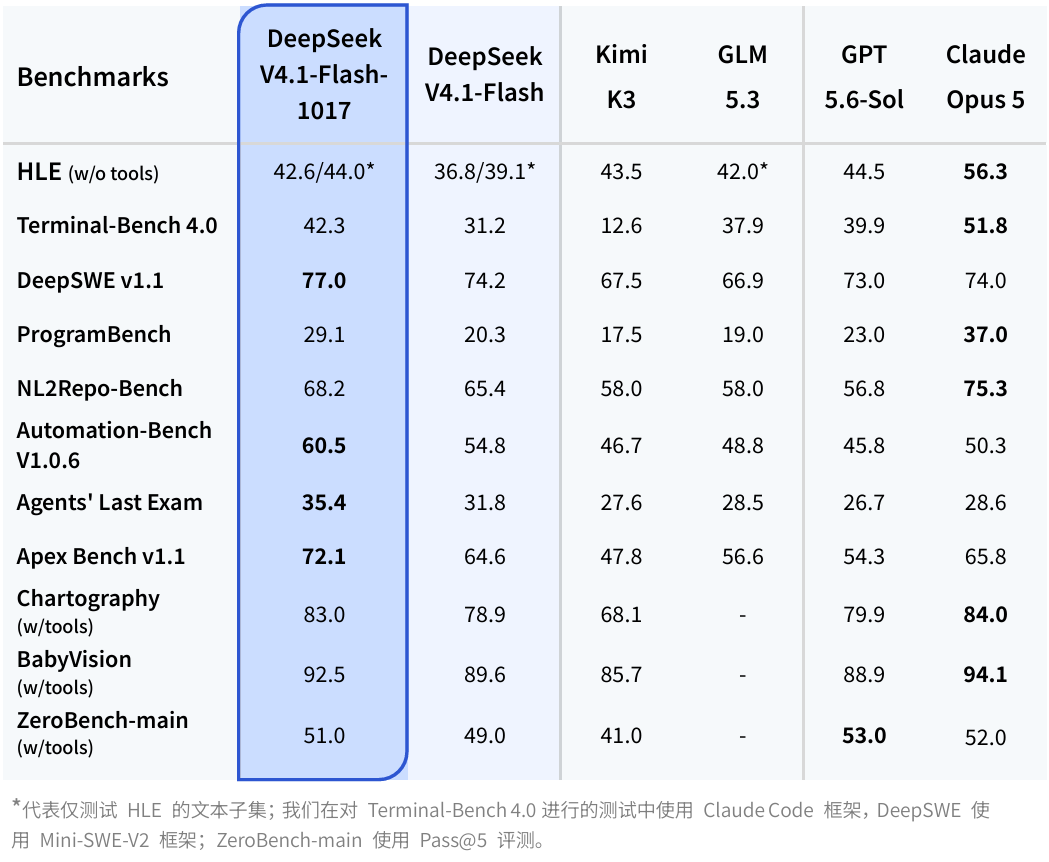
Figure: DeepSeek’s official benchmark table for V4.1-Flash-1017 (source: api-docs.deepseek.com, captured 2026-10-19)
DeepSeek updated V4.1 Flash to V4.1-Flash-1017 on October 17. The changelog headline is “wish-driven programming”, with a benchmark table, a performance-cost chart and four case images. I downloaded them and compared the numbers.
The short version: this is an execution upgrade, not a knowledge upgrade. Agent, terminal and coding scores moved; knowledge scores moved less; the price is unchanged.
Benchmark table: the biggest gains are hands-on
| Benchmark | Previous | 1017 | Change |
|---|---|---|---|
| HLE (no tools) | 36.8 | 42.6 | +5.8 |
| Terminal-Bench 4.0 | 31.2 | 42.3 | +11.1 |
| DeepSWE v1.1 | 74.2 | 77.0 | +2.8 |
| ProgramBench | 20.3 | 29.1 | +8.8 |
| NL2Repo-Bench | 65.4 | 68.2 | +2.8 |
| Automation-Bench | 54.8 | 60.5 | +5.7 |
| Chartography (tools) | 78.9 | 83.0 | +4.1 |
| BabyVision (tools) | 89.6 | 92.5 | +2.9 |
Terminal-Bench +11.1 and ProgramBench +8.8 are the story: both measure whether the model can act, check its work and fix it.
Performance-cost chart
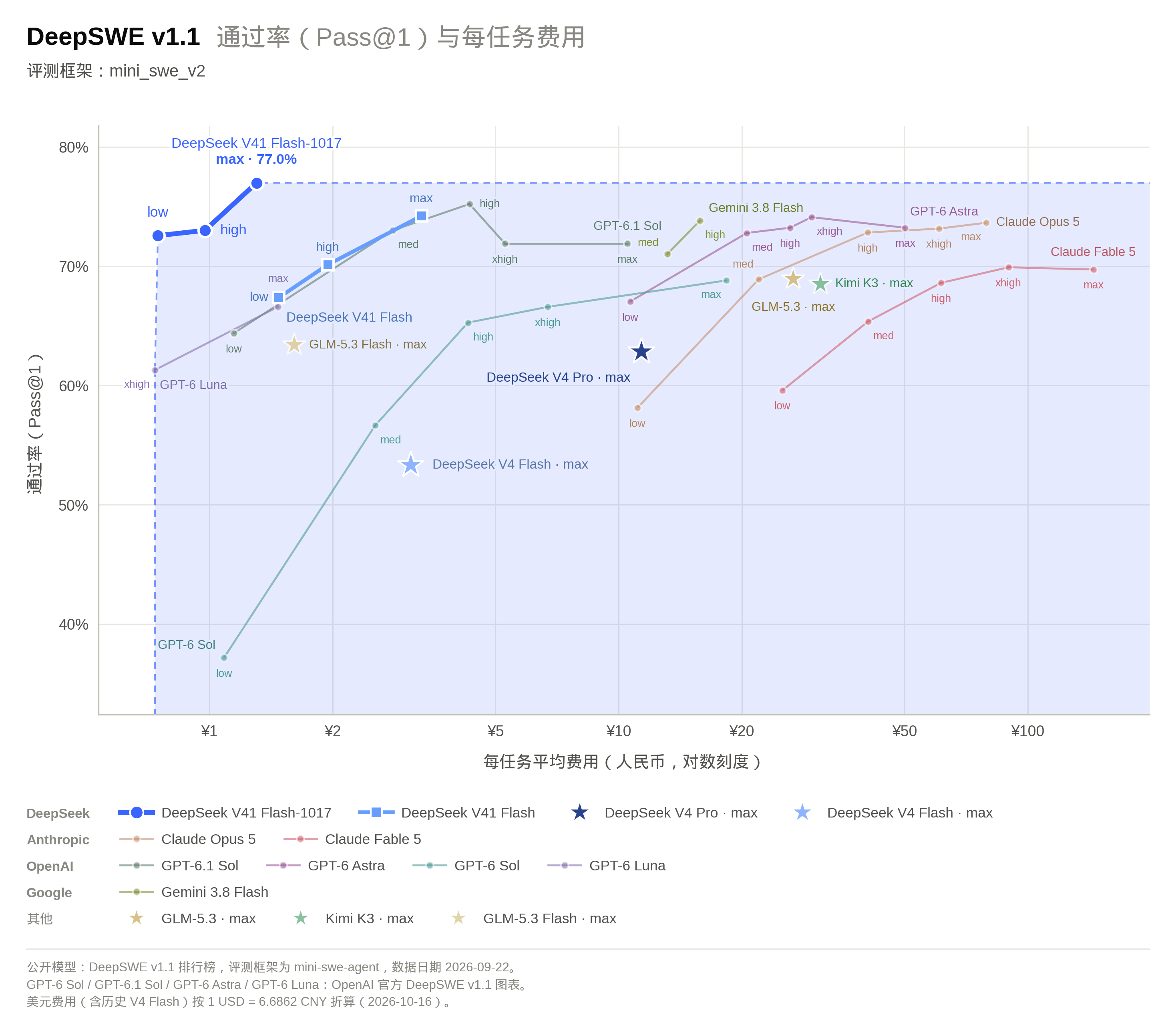
Figure: Official performance-cost Pareto chart (source: api-docs.deepseek.com, captured 2026-10-19)
The chart claims a new Pareto frontier: more performance for the same cost, or the same performance for less. Output length also dropped, which reduces tokens and therefore the bill.
The four cases

Figure: Official case 1 (source: api-docs.deepseek.com, captured 2026-10-19)
“Wish-driven programming” means describing what you want, and the model plans, writes, runs and fixes. The cases show that loop, not code snippets.
Model card and access
The API name is still deepseek-flash, and the price is unchanged. Upgrade DeepSeek Harness to 0.2.1-rc.1 or newer; the harness matters as much as the model.
Search API and GEO filtering
DeepSeek also opened a search API with a trillion-page index and filtering for SEO spam, GEO manipulation and low-quality AIGC. Good for RAG, but it also means answers depend on what the model reads.
How I would test it
- A long task in a real repo: read, fix a test, run, commit.
- Tool-call format: a complex schema, check for missing fields.
- Cost: tokens times rounds, not price per million tokens.
What it is not for
Long context, high-precision reasoning, fine visual detail, long autonomous runs without checkpoints.
What the table does not say
Benchmark harnesses differ, Pass@5 inflates usability, and the cases are selected. Treat the table as a starting point.
My take
V4.1-Flash-1017 raises the execution floor without raising the price. For agents and batch jobs it is worth switching; for single-turn Q&A you will barely notice.
Comments
…